

Imagine if the American Dream needed a good Wi-Fi connection. It’s not just about giving out gadgets. It’s about making sure every student can join the 21st century.The National Forum on Education Statistics says it best. It’s about having the technology capacity to fully participate in society and the economy. This simple phrase hides a…
Imagine if the American Dream needed a good Wi-Fi connection. It’s not just about giving out gadgets. It’s about making sure every student can join the 21st century.
The National Forum on Education Statistics says it best. It’s about having the technology capacity to fully participate in society and the economy. This simple phrase hides a harsh reality – students without the right tech are left out.
In some classrooms, the digital divide is very real. Some students easily use online tools, while others face basic connectivity issues. It’s the difference between doing homework after school and education stopping at the final bell.
True digital equity makes technology a leveler. As the Office of Educational Technology notes, it means everyone has the tools, access, and skills to succeed. Not just get by.
Device & Internet Access
Having a smartphone doesn’t mean you have access to educational technology. It’s like saying you’re a chef just because you have a microwave. The truth about edtech equity is much more complicated than just counting devices.
National data shows four big barriers to students’ learning:
- Household Finances: When families have to choose between food and internet, education loses
- Inadequate Devices: Smartphones are great for TikTok, but not for school software
- Infrastructure Challenges: Internet in rural areas is as weak as a politician’s handshake
- Slow Internet Speeds: Internet is so slow, it’s like watching video buffering from the 90s
Students try to code on tiny smartphone screens. It’s like trying to solve a Rubik’s Cube with oven mitts. The Office of Educational Technology says true access means having enough bandwidth and devices that work.
Modern buildings often block signals, creating digital dead zones. Students trying to stream classes in these areas are like trying to get a signal from a Faraday cage. It’s not just about being connected; it’s about having quality connection.
The National Forum on Education Statistics says these barriers make education unequal. Your education quality depends on your area’s internet speed. Real edtech equity means having fast, reliable internet.
The solution isn’t just giving out devices. It’s making sure they can handle school software. It’s also about having internet speeds that support video calls without freezing.
True digital access means every student has technology that works as hard as they do. In the fight for educational equality, we can’t let students be held back by slow technology.
National Programs
National programs are like the star cast of a blockbuster movie, getting the funding they deserve. Remember when the internet was a luxury? The 2021 Infrastructure Investment and Jobs Act gave $65 billion to broadband, like it was the final season of Game of Thrones.
This isn’t just throwing money at problems. It’s recognizing that tech access in education needs the same priority as roads and bridges. You can’t Zoom to class on a pothole.
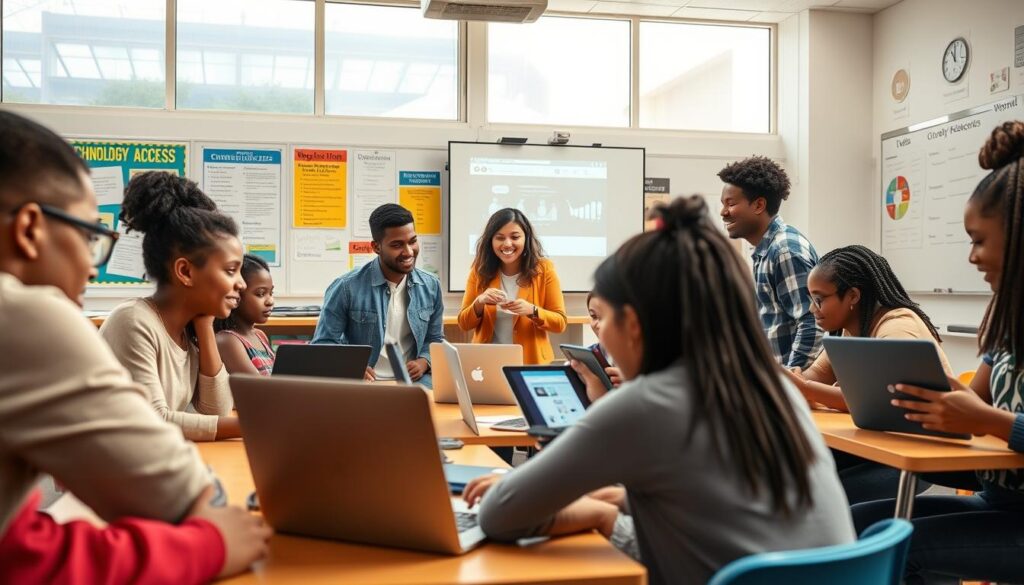
The E-Rate program is like the wise elder statesman, connecting schools and libraries for years. While other programs get the headlines, E-Rate quietly keeps institutions online without breaking the bank.
States like Massachusetts are leading the way, not waiting for federal help. The Massachusetts Broadband Institute has created innovative programs that make tech startups jealous:
- Digital Equity Partnerships that bring together public and private sectors
- Municipal planning frameworks that recognize local needs
- Implementation strategies that actually work in the real world
These initiatives know that digital equity isn’t about one-size-fits-all solutions. What works in Boston might not work in the Berkshires. The key is having the right playbook and vocabulary.
The Learning Accelerator’s Digital Equity Guide provides the strategic blueprint. The National Digital Inclusion Alliance offers the essential definitions. You can’t solve a problem you can’t properly name, as highlighted in this comprehensive analysis of digital inclusion frameworks.
Here’s how these programs stack up in the battle for educational connectivity:
| Program | Funding Scope | Primary Focus | Implementation Level |
|---|---|---|---|
| Infrastructure Act | $65 billion | National broadband expansion | Federal |
| E-Rate Program | Ongoing funding | Schools & libraries connectivity | Institutional |
| Massachusetts Broadband Institute | State appropriations | Municipal digital equity planning | Local/Regional |
| Digital Equity Partnerships | Public-private funding | Community-specific solutions | Municipal |
This multi-layered approach is the grown-up version of tech access in education. Instead of piecemeal solutions, we’re seeing coordinated efforts. These efforts recognize that connectivity requires federal muscle, state innovation, and local intelligence all working together.
It’s not just about getting devices into hands anymore. It’s about building ecosystems where educational technology works for everyone. The national programs leading this charge understand that digital equity is an ongoing process of adaptation and improvement.
Closing the Homework Gap
Imagine trying to write a research paper with internet that keeps dropping. It’s like racing in a Formula 1 car but with a golf cart. The homework gap shows how the digital divide affects education, making inequality a daily struggle.
Almost 17% of American students don’t have enough internet at home. That’s one in five kids trying to do their homework with a big disadvantage. The National Forum says, “The homework gap is a direct result of the digital divide.”

Schools are finding creative ways to help. Jonesboro Public Schools added translation features for over 100 languages. They know that digital equity means everyone can access it, not just English speakers.
Bozeman School District made online learning work for all families. Noblesville Schools even hired English learner liaisons. They understand that technology needs support to be useful.
These efforts are not just charity. They’re smart investments in education. The homework gap affects more than grades; it impacts the future. Without reliable internet, students can’t keep up with online homework.
Closing the homework gap means accepting that homework is now online. The solutions aren’t about fancy tech. They’re about making technology work for people in their communities.
Community Partnerships
Community partnerships in education are like a dream team for tech startups. Everyone brings their skills to solve big problems. Schools have turned into community centers through smart collaborations that boost edtech equity.
Local tech companies giving old devices to schools is smart, not just charity. It’s about creating an “educational circular economy.” Old laptops get a new life in students’ hands. It’s good for the planet and helps students learn.
ISP partnerships make sure everyone has internet access. Companies offer cheap plans to low-income families. This isn’t just about being responsible; it tackles the digital divide barriers that hold students back.
Wi-Fi hotspot programs are a creative solution. Schools become internet providers, bringing the internet to students. It’s a necessary innovation.
The Office of Educational Technology knows what works. Sustainable edtech equity comes from community efforts. Schools, businesses, and cities work together to make digital access a community standard.
The best partnerships see digital equity as a shared challenge. When local businesses, governments, and schools team up, they create lasting solutions. It’s about working together to achieve more than alone.
Student Stories
Tech access in education is about unlocking human dreams. I recall a student doing homework in a fast-food parking lot for Wi-Fi. Their drive was inspiring, but the situation was sad. These stories are common. Nearly half of lower-income households can’t afford it, creating a homework gap.
Early help can change lives. When students get the tech they need, amazing things happen. Shy students find their voice through digital projects. Struggling students understand better with adaptive tools. Research shows that targeted efforts can close the achievement gap.
These tales show that giving tech is giving hope. Every device means a chance for a student to succeed. The effects go beyond school, shaping careers and communities. We’re not just solving a tech problem—we’re shaping futures.
James develops culturally responsive teaching frameworks and equity audit tools used by
over 150 school districts. A former high school teacher, he brings classroom experience to…