
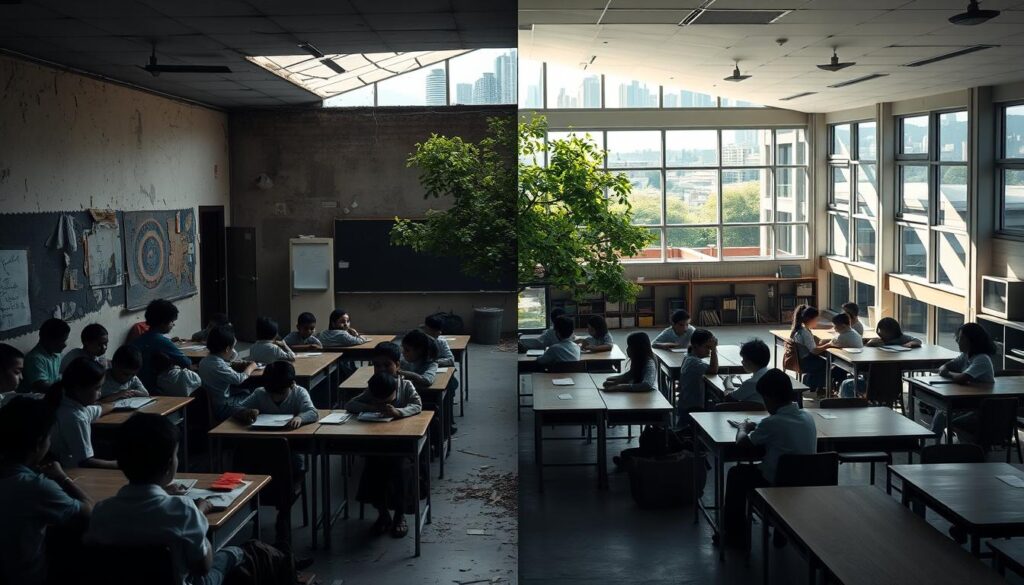
Welcome to America’s educational reality show. Here, the grand prize is breathable air, and the consolation prize is learning about HVAC systems. Some students learn in top-notch environments, while others face outdated classrooms.The World Bank says the physical design of schools affects learning. Yet, we have a school facility gap that would shock Charles Dickens.…
Welcome to America’s educational reality show. Here, the grand prize is breathable air, and the consolation prize is learning about HVAC systems. Some students learn in top-notch environments, while others face outdated classrooms.
The World Bank says the physical design of schools affects learning. Yet, we have a school facility gap that would shock Charles Dickens. I’ve seen classrooms where the temperature changes require more layers than a Shakespearean plot.
Brookings Institution found 36,000 schools need better climate control. The worst cases are in our most vulnerable communities. It’s like educational apartheid by architecture – some kids get modern classrooms, while others get old ones.
This isn’t just about comfort. It’s about whether a child can focus in questionable air. The answer might be in changing how we approach education. Successful community schools are transforming learning environments against all odds.
Impacts on Outcomes
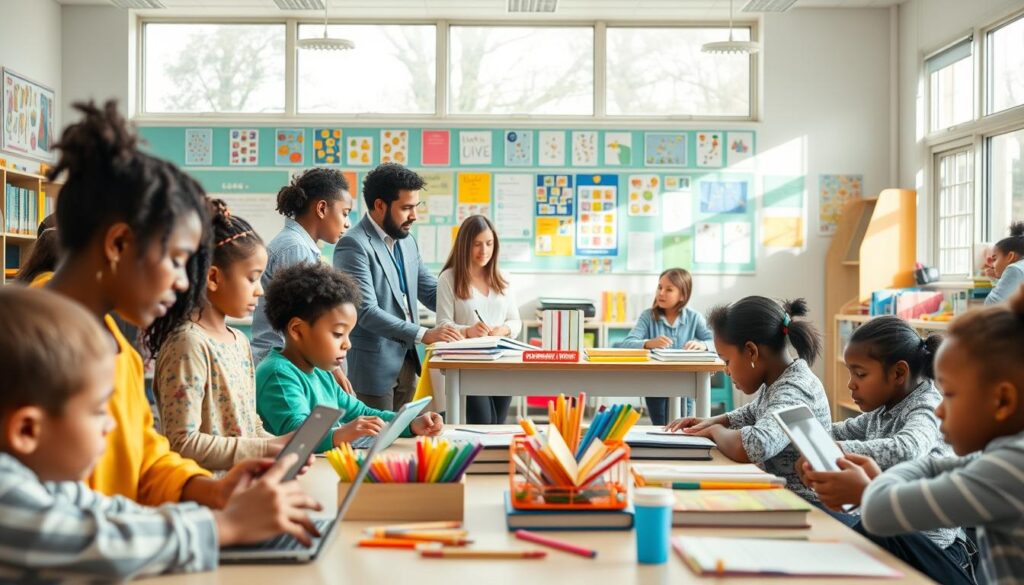
Ever tried solving quadratic equations with water dripping on your textbook? The educational playing field is not just uneven—it’s sabotaged. Facility conditions can greatly affect academic success.
The World Bank’s research shows that students in better environments do better. We’re not talking about small improvements. We’re talking about huge differences, like wearing sneakers versus concrete boots.
Brookings found that schools with bad facilities see big drops in test scores and attendance. It’s not just about feeling comfortable. Extreme temperatures, poor air, and bad lighting make learning harder.
- Math scores drop by 10-15% compared to peers in modern buildings
- Attendance rates decline by 5-7 days per school year
- Asthma rates increase by 20-30% in buildings with mold or poor ventilation
This isn’t just about school quality transmission of inequality. It’s about physical barriers to learning. The most vulnerable students face challenges twice: by circumstance and by infrastructure.
The achievement gap isn’t just in test scores. It’s in things like temperature, air quality, and noise levels. When we talk about the opportunity gap, we often overlook the most obvious factor: the buildings where learning happens.
| Facility Condition | Impact on Test Scores | Attendance Impact | Health Outcomes |
|---|---|---|---|
| Poor HVAC Systems | -12% Math Performance | 5-7 absent days/year | 25% higher asthma rates |
| Inadequate Lighting | -8% Reading Comprehension | 3-4 absent days/year | 15% more eye strain cases |
| Overcrowded Classrooms | -10% Overall Performance | 4-6 absent days/year | 20% higher illness transmission |
True resource equity in schools means every student learns in supportive environments. Fixing buildings is not just about repairs. It’s about rebuilding opportunities.
Facility Funding Gaps
The Government Accountability Office found a big problem: schools in need get the least funding. It’s not just unfair – it’s a system that makes some schools worse off than others. Your school’s condition can depend on where you live.
Looking at the money, we see the issue. Rich areas pass bonds for fancy schools, while poor ones just try to fix leaks. Some districts’ facility budgets are less than what a Silicon Valley startup spends on coffee.
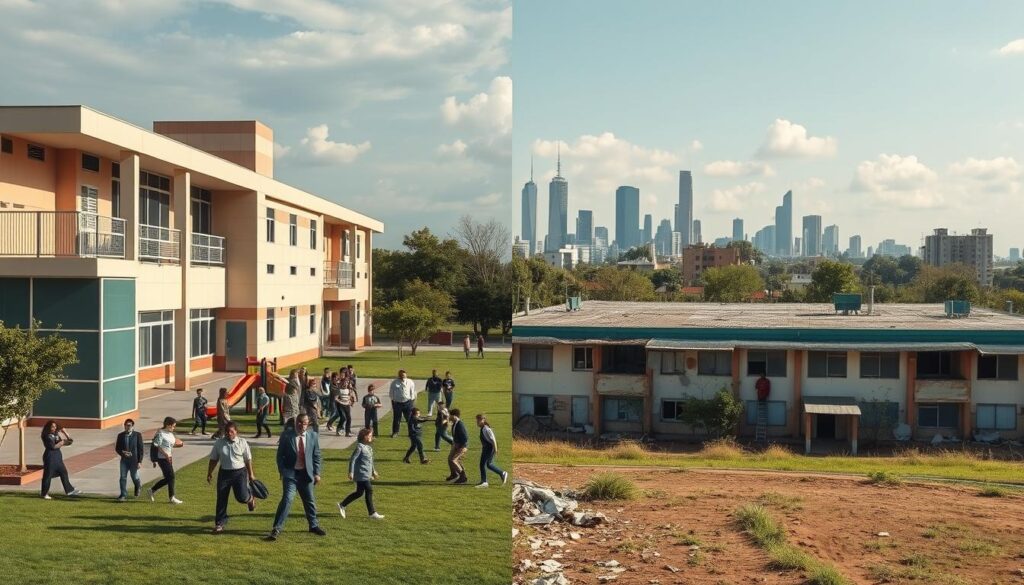
Research by the Brookings Institution points to the main problem: most funding comes from local sources. This creates a school facility gap that shows how rich or poor a neighborhood is. Rich areas get fancy tech, while poor ones just hope the heat works.
This isn’t just a mistake. It’s a design flaw. We’ve made a system that ensures the school facility gap gets bigger. It’s like a caste system based on how much land you own.
Studies on school finance show how deep these problems are. Some states have funding ratios of 3:1 between the richest and poorest districts. That’s a huge gap, not just a difference.
We’re running two education systems. One has fancy pools and labs, while the other has broken ceilings and old science equipment. The school facility gap affects students’ health and grades.
To fix this, we need to admit that our current funding system is broken. We can’t rely on local property taxes to fund schools in all kinds of communities.
Fixing this isn’t about more bake sales or bonds that only rich areas can pass. We need big changes to solve the school facility gap. Anything less is just a temporary fix.
Advocating for Modernization
We’ve been using duct tape and hope to fix problems that need real solutions. The World Bank’s RIGHT+ framework offers a smarter way. It treats schools as places where learning happens, not just leaky containers.
This isn’t about fancy buildings. It’s about making sure schools have what they need to support learning. Brookings Institution agrees: we need federal money for green schools and better air quality. Schools should be more than just places to learn; they should be community hubs.
Local funding models have led to “educational apartheid,” where where zip codes decide what schools get. We need to see school infrastructure as a national security issue. The Kappan analysis shows how zip codes affect learning conditions.
Every child deserves a safe, healthy place to learn. We have the plans, technology, and public support. Now, we need the courage to make schools a priority, not just a buzzword.
James develops culturally responsive teaching frameworks and equity audit tools used by
over 150 school districts. A former high school teacher, he brings classroom experience to…