
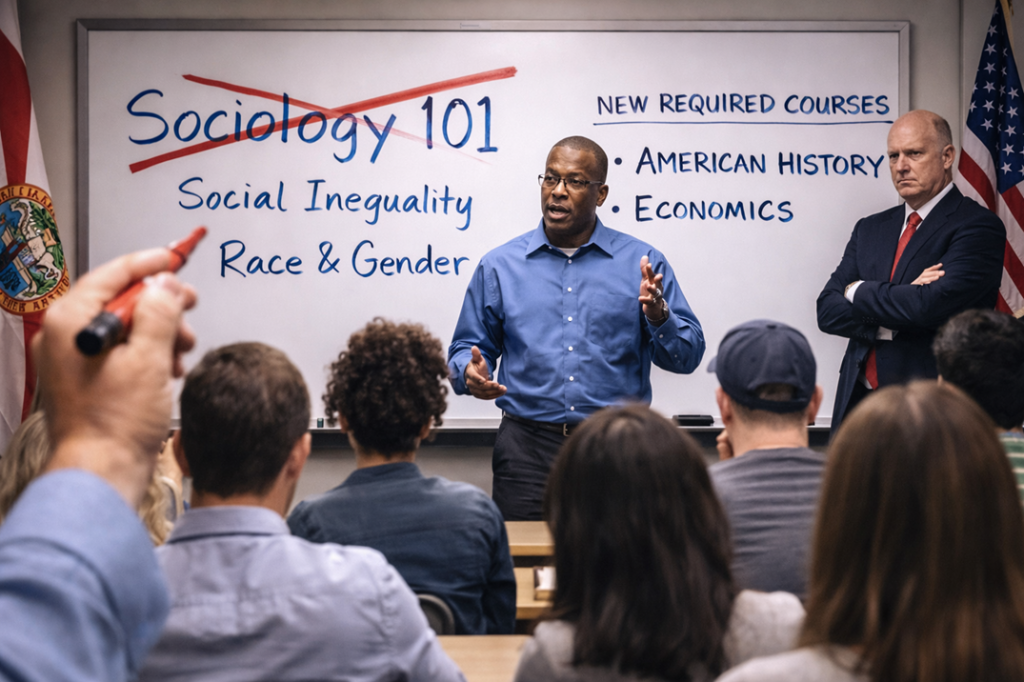
Recent decisions in Florida’s public university system to remove sociology as a general education requirement have reignited debates about academic freedom and political influence in higher education. While framed as a restructuring of core curricula, the move reflects a broader national trend in which state policy is increasingly shaping what students are required—or allowed—to learn.…
Recent decisions in Florida’s public university system to remove sociology as a general education requirement have reignited debates about academic freedom and political influence in higher education. While framed as a restructuring of core curricula, the move reflects a broader national trend in which state policy is increasingly shaping what students are required—or allowed—to learn.
Sociology, as a discipline, often examines systemic inequality, race, gender, and social institutions. Its removal from foundational coursework raises questions not only about academic priorities, but about whose knowledge is considered essential in preparing students for civic life.
What may appear as a technical curriculum adjustment is, in practice, a significant shift in how universities define educational value.
The Intersection Of Curriculum Control And Political Influence
Higher education has historically maintained a degree of autonomy over curriculum design. However, recent policy interventions in Florida signal a shift toward greater state involvement in determining academic content.
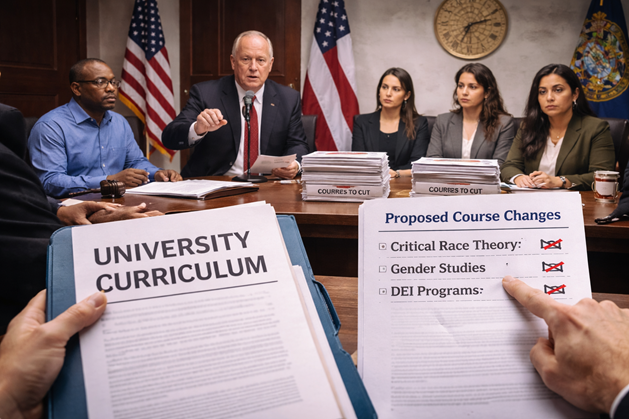
Supporters of the change argue that general education requirements should prioritize workforce readiness and avoid what they view as ideologically driven material. Critics, however, see the removal of sociology as part of a broader effort to limit discussions of systemic inequality and social justice within academic settings.
This tension reflects a fundamental question: who should decide what constitutes a “core” education—the academic community or political leadership?
The answer increasingly appears to be negotiated rather than assumed, with significant implications for institutional independence.
Academic Freedom Under Pressure
The removal of sociology requirements highlights a growing concern about the erosion of academic freedom. While individual faculty members retain the ability to teach their courses, the broader structure of what students are required to learn is being reshaped externally.
Academic freedom traditionally encompasses not only the right to teach and research freely, but also the ability of institutions to determine curricula based on disciplinary expertise. When external actors influence these decisions, the boundaries of academic freedom begin to shift.
This development does not necessarily eliminate academic freedom, but it redefines it—placing constraints on how knowledge is prioritized and disseminated at scale.
What Students Lose When Disciplines Are Removed
The impact of removing sociology from general education extends beyond departmental concerns. It affects how students understand complex social systems, civic responsibility, and their role in a diverse society.
The table below outlines key areas of learning affected by this shift:
| Learning Area | Contribution Of Sociology | Potential Gap After Removal |
|---|---|---|
| Social Inequality | Analysis of systemic disparities | Reduced exposure to structural perspectives |
| Civic Engagement | Understanding institutions and participation | Narrower view of democratic processes |
| Critical Thinking | Evaluating social data and narratives | Less emphasis on societal context |
| Cultural Awareness | Exploration of identity and diversity | Limited representation of lived experiences |
Without required exposure to these frameworks, students may graduate with strong technical skills but a more limited understanding of the social environments in which those skills are applied.
The Broader Pattern Of Curriculum Restriction
Florida’s decision is part of a broader national pattern in which certain disciplines and topics are being reevaluated—or restricted—based on political priorities. Courses addressing race, gender, and systemic inequality have become focal points in these debates.
This trend intersects with ongoing changes in institutional policy, including the restructuring of diversity initiatives and shifts in governance. As seen in discussions around campus inclusion policy shifts, curriculum decisions are increasingly connected to broader questions of equity and representation.
The cumulative effect is a redefinition of what universities are expected to provide: not just education, but a particular vision of knowledge aligned with evolving policy frameworks.
Institutional Strategy In A Politicized Environment
Universities operating in this environment must navigate complex and often competing demands. They are accountable to state governments, federal regulations, and their own academic missions—all while responding to student and faculty concerns.
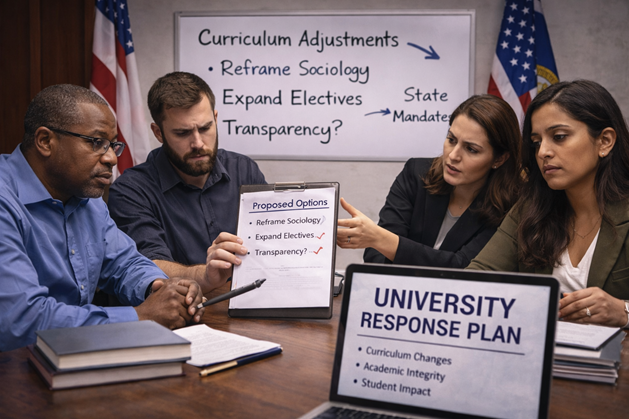
Institutional strategies may include:
- Reframing sociology content within other disciplines
- Expanding elective pathways to preserve access to social science perspectives
- Strengthening interdisciplinary programs that integrate social analysis
- Enhancing transparency around curriculum decisions
These approaches aim to balance compliance with policy mandates while maintaining educational integrity. However, they also highlight the limitations institutions face when external constraints shape internal decisions.
Legal And Policy Context Shaping Curriculum Decisions
The legal framework surrounding curriculum control is evolving. While states have authority over public university systems, federal protections related to civil rights and academic freedom continue to influence institutional responsibilities.
Recent reporting on academic freedom debates in Florida universities illustrates how these tensions are playing out in real time, with faculty, administrators, and policymakers offering competing interpretations of educational priorities.
Universities must operate within this layered framework, ensuring that curriculum changes do not undermine compliance with broader legal obligations or compromise access to inclusive educational experiences.
Rethinking The Purpose Of General Education
At its core, the removal of sociology requirements prompts a deeper reflection on the purpose of general education. Is it meant to prepare students solely for employment, or to equip them with the knowledge needed to navigate a complex and diverse society?
General education has traditionally served as a foundation for both professional and civic development. Limiting exposure to disciplines that examine social structures may narrow that foundation, even as it aligns with certain policy objectives.
The challenge for universities is to reconcile these competing visions in a way that preserves both rigor and relevance.
What This Signals For The Future Of Higher Education
The politicization of curriculum decisions is likely to remain a defining feature of higher education in the coming years. As states take a more active role in shaping academic content, universities will need to adapt without losing sight of their core mission.
This moment represents both a constraint and an inflection point. Institutions have the opportunity to rethink how they deliver inclusive, comprehensive education—even within shifting policy boundaries.
Ultimately, the future of academic freedom will depend not only on formal protections, but on how institutions, educators, and policymakers negotiate the balance between autonomy and accountability.
The removal of sociology requirements is not just about one discipline—it is about how higher education defines knowledge, prepares students, and responds to the evolving intersection of education and politics.
James develops culturally responsive teaching frameworks and equity audit tools used by
over 150 school districts. A former high school teacher, he brings classroom experience to…