
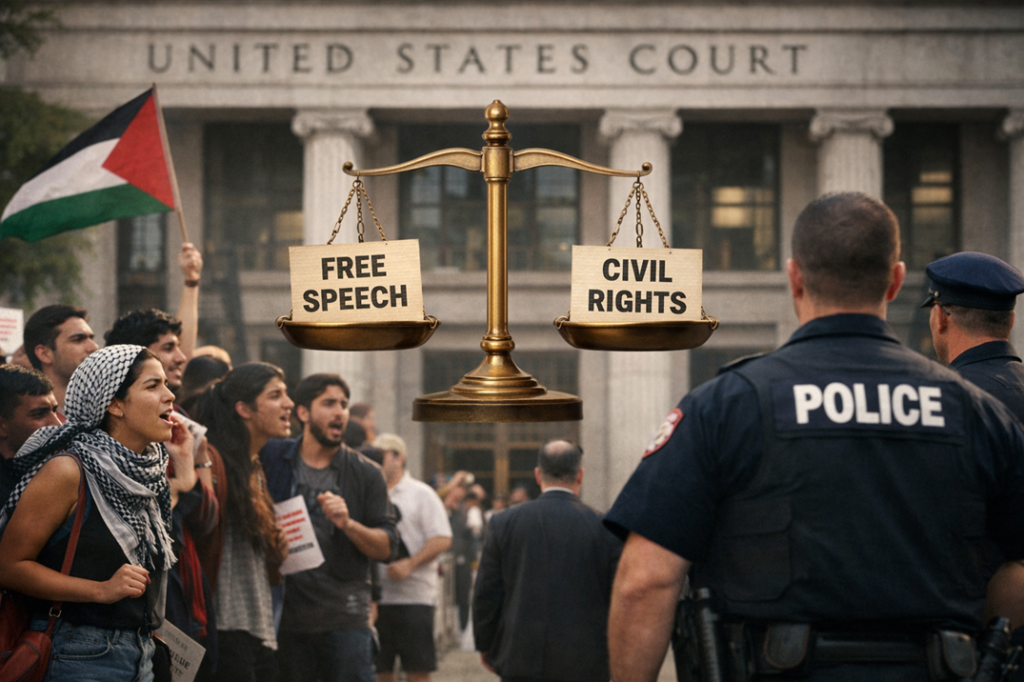
Recent court rulings and lawsuits tied to pro-Palestinian protests and antisemitism claims are forcing universities across the United States to confront a fundamental tension: how to uphold free speech while ensuring compliance with federal civil rights law. Institutions that once treated protest management as a student affairs issue are now navigating a far more complex…
Recent court rulings and lawsuits tied to pro-Palestinian protests and antisemitism claims are forcing universities across the United States to confront a fundamental tension: how to uphold free speech while ensuring compliance with federal civil rights law.
Institutions that once treated protest management as a student affairs issue are now navigating a far more complex legal landscape. The stakes have shifted from maintaining campus order to demonstrating that policies and responses do not create discriminatory environments under Title VI.
The result is a new era where student protests are no longer evaluated solely through the lens of expression, but through their impact on campus safety, inclusion, and institutional accountability.
The Legal Collision Between The First Amendment And Title VI
At the heart of current litigation is a perceived conflict between two foundational principles. On one side, public universities are bound by the First Amendment, which protects even controversial or offensive speech. On the other, Title VI requires institutions receiving federal funding to prevent discrimination based on race, color, or national origin.
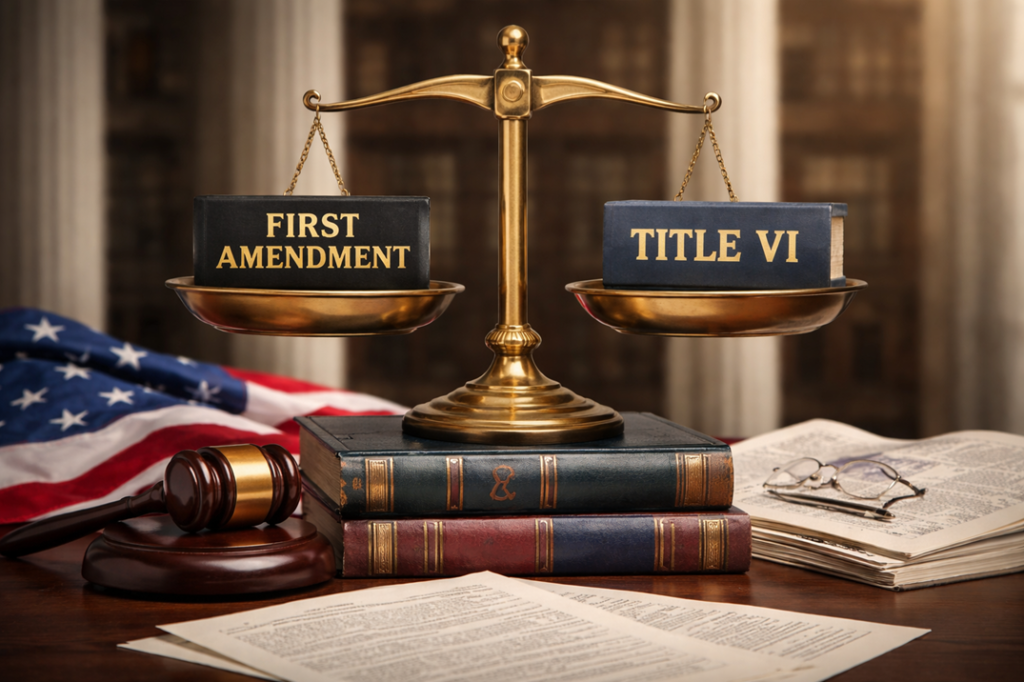
Recent cases highlighted in national reporting show how these frameworks are colliding. Allegations that certain protest activities contribute to hostile environments for Jewish students have triggered lawsuits arguing that universities failed to meet their civil rights obligations.
This legal tension raises a critical question: when does protected speech cross into actionable discrimination?
Federal guidance does not offer a simple threshold. Instead, institutions must assess whether conduct is “severe, pervasive, and objectively offensive” enough to deny equal access to education—a standard that is highly context-dependent and increasingly contested.
Court Rulings Are Expanding Institutional Responsibility
What distinguishes the current wave of cases is not just the subject matter, but the expectations placed on universities. Courts and federal agencies are signaling that passive neutrality may no longer be sufficient.
Universities are being asked to demonstrate that they have:
- Clear policies distinguishing protected speech from harassment
- Mechanisms for timely response to student complaints
- Evidence of consistent enforcement across different groups
- Preventive strategies, not just reactive measures
The table below illustrates how institutional expectations are evolving:
| Dimension | Traditional Approach | Emerging Legal Expectation |
|---|---|---|
| Free Speech Policy | Broad protection statements | Detailed, context-specific guidance |
| Protest Management | Focus on safety and logistics | Integration with civil rights compliance |
| Institutional Role | Neutral facilitator | Active risk manager |
| Complaint Handling | Case-by-case response | Pattern-based assessment and documentation |
| Accountability | Internal review | External legal and federal scrutiny |
This shift reflects a broader legal trend: universities are increasingly judged not only by what they allow, but by how their environments affect different student groups.
The Role Of Campus Climate In Legal Interpretation
One of the most significant developments in recent rulings is the centrality of campus climate as a legal concept. Courts are increasingly willing to consider how speech and protest activity contribute to an overall environment that may be exclusionary or hostile.
This aligns with federal enforcement trends that treat student experiences as key evidence. Surveys, complaint data, and documented incidents are used to determine whether institutions have met their obligations.
Importantly, this approach does not require universities to eliminate controversial speech. Instead, it requires them to demonstrate that such speech does not result in unequal access to educational opportunities.
This distinction is critical—and difficult to operationalize. Universities must balance competing rights while maintaining environments that meet evolving legal standards.
Student Protest As A Governance And Equity Issue
Beyond legal compliance, student protests are increasingly understood as indicators of deeper governance challenges. Protests often emerge when students perceive that institutional structures are unresponsive to their concerns.
In this context, restricting or mismanaging protests can exacerbate tensions rather than resolve them. Universities that rely solely on disciplinary approaches may find themselves facing both legal challenges and declining trust.
This is where participatory governance becomes essential. Institutions that integrate student-led accountability structures into policy development are better positioned to navigate contentious issues before they escalate into crises.
By involving students in decision-making processes, universities can create clearer expectations, reduce ambiguity, and build legitimacy around policy enforcement.
Policy Design In An Era Of Legal Uncertainty
The current landscape requires universities to rethink how protest policies are designed and implemented. Static policies are no longer sufficient in an environment where legal interpretations are rapidly evolving.
Effective policy design now requires:
- Flexibility to adapt to changing legal standards
- Clarity in defining unacceptable conduct
- Transparency in enforcement processes
- Alignment between free speech protections and civil rights obligations
Universities must also invest in training for administrators, faculty, and campus security to ensure consistent application of policies across different contexts.
Without these investments, institutions risk uneven enforcement—one of the key factors driving current litigation.
What This Means For Universities Nationwide
The implications of recent court rulings extend far beyond the specific cases currently in the headlines. They represent a broader recalibration of how higher education institutions are expected to operate within a democratic society.
Universities are no longer just arenas for debate; they are accountable environments where rights must be balanced in practice, not just in principle.
As outlined in recent reporting on campus protest lawsuits and antisemitism claims, institutions that fail to navigate this balance effectively may face not only legal consequences but also long-term damage to their credibility and mission.
Reframing Free Speech As A Shared Institutional Responsibility
The emerging legal landscape suggests that free speech and civil rights are not opposing forces, but interconnected responsibilities. Protecting one without addressing the other is no longer a viable strategy.
Universities must move beyond binary frameworks and adopt integrated approaches that recognize the complexity of modern campus environments. This includes investing in dialogue, prevention, and inclusive policy design.
Ultimately, the future of campus free expression will depend on whether institutions can create conditions where all students feel both heard and protected. Achieving this balance is no longer optional—it is a defining challenge for higher education in the years ahead.
James develops culturally responsive teaching frameworks and equity audit tools used by
over 150 school districts. A former high school teacher, he brings classroom experience to…