
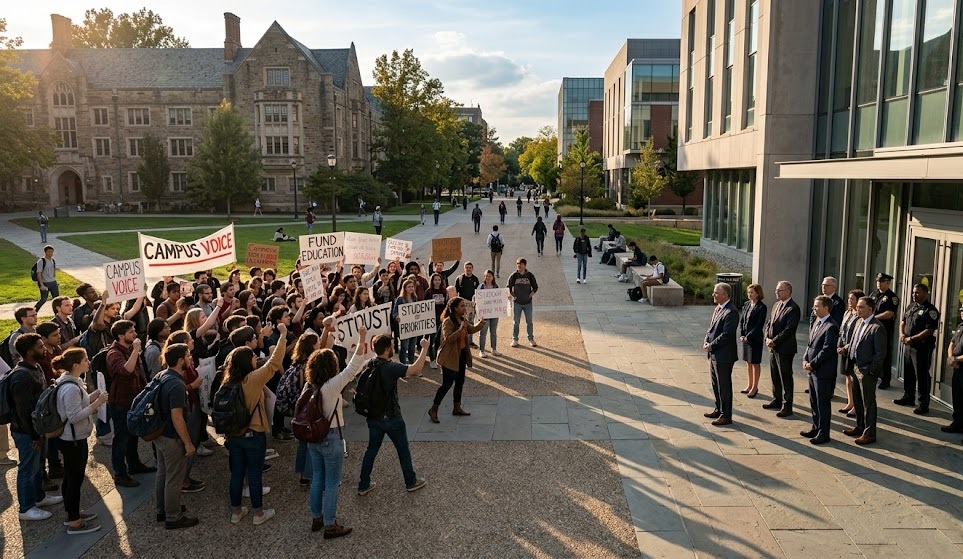
Campus protests have long been a defining feature of higher education in the United States, but recent waves of student activism—particularly tied to global conflicts, civil rights concerns, and campus safety—are producing a new kind of response: direct federal intervention. In 2024 and 2025, protests at universities such as Columbia, Harvard, and the University of…
Campus protests have long been a defining feature of higher education in the United States, but recent waves of student activism—particularly tied to global conflicts, civil rights concerns, and campus safety—are producing a new kind of response: direct federal intervention.
In 2024 and 2025, protests at universities such as Columbia, Harvard, and the University of California system drew national attention, prompting investigations by the U.S. Department of Education and congressional hearings. What distinguishes this moment is not simply the scale of activism, but the degree to which it has triggered formal policy review at the federal level.
Student protests are no longer confined to campus boundaries. They are increasingly catalysts for regulatory action, reshaping how institutions are evaluated under civil rights law.
When Protest Becomes A Civil Rights Issue
The transformation of campus protests into civil rights concerns reflects a shift in how federal agencies interpret institutional responsibility. Under Title VI, universities are required to ensure that students are not subjected to discrimination based on race, color, or national origin.
Recent complaints filed with the Office for Civil Rights have argued that certain protest environments—particularly those involving antisemitism or Islamophobia—may create hostile conditions that limit students’ access to education.
This raises a critical distinction: while protest itself is protected expression, its effects may still trigger institutional obligations if they contribute to discriminatory environments.
Federal guidance emphasizes that universities must balance these dynamics carefully, ensuring that responses to protests address harm without suppressing lawful expression.
Federal Investigations As A Policy Mechanism
Federal intervention is increasingly taking the form of investigations, compliance reviews, and public reporting. These mechanisms serve both regulatory and signaling functions, indicating how institutions are expected to respond to evolving campus dynamics.

The U.S. Department of Education’s Office for Civil Rights has expanded its focus on campus climate, examining not only individual incidents but patterns of institutional response.
The table below illustrates how federal intervention operates in the context of campus protests:
| Mechanism | Purpose | Institutional Impact |
|---|---|---|
| Civil Rights Investigations | Assess compliance with Title VI | Requires documentation and policy review |
| Compliance Agreements | Mandate corrective action | Forces structural changes in procedures |
| Public Reporting | Increase transparency | Influences public perception and accountability |
| Congressional Hearings | Apply political pressure | Shapes national policy direction |
These tools collectively reinforce the expectation that universities must actively manage the consequences of protest activity, not just permit it.
Institutional Decision-Making Under Pressure
University leaders are now making decisions in an environment shaped by legal risk, public scrutiny, and political pressure. Responses to protests—such as disciplinary action, policy revisions, or public statements—are interpreted as indicators of institutional values and compliance.
This creates a governance challenge: actions that satisfy one stakeholder group may provoke criticism from another. For example, restricting protests to prevent harassment may be seen as necessary for safety, but also as limiting free speech.
Institutions must therefore develop decision-making frameworks that are both principled and adaptable. This includes clear policies, consistent enforcement, and transparent communication.
The complexity of these decisions reflects a broader shift in higher education governance, where external accountability is increasingly intertwined with internal policy.
Student Activism As A Driver Of Structural Reform
Despite the challenges it creates, student activism remains one of the most powerful forces for institutional change. Historically, protests have led to significant reforms, from civil rights policies in the 1960s to more recent changes in campus safety and inclusion initiatives.
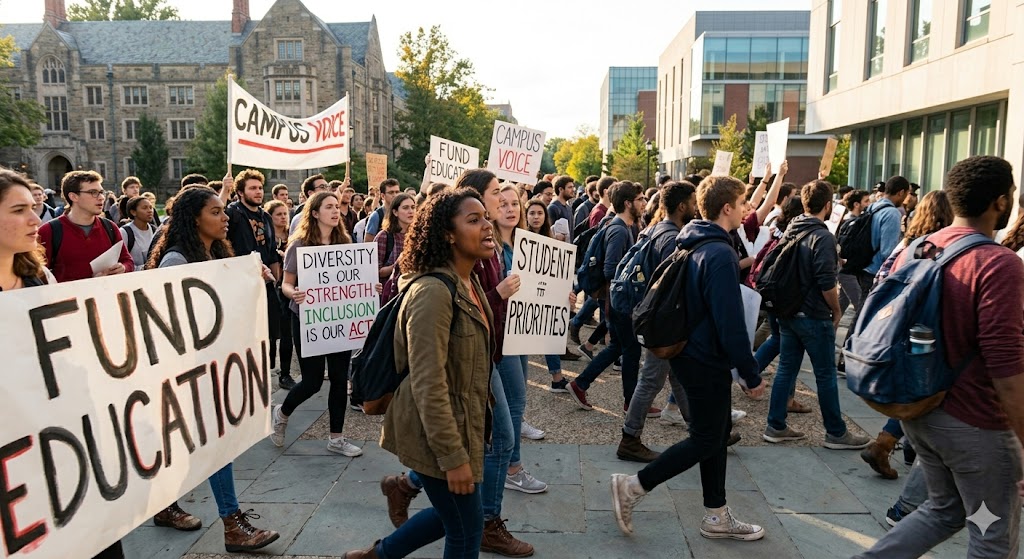
In the current context, activism is influencing:
- The expansion of bias reporting systems
- Revisions to protest and demonstration policies
- Increased investment in campus safety measures
- Greater federal oversight of institutional practices
This dynamic underscores the role of students not just as participants in education, but as active agents shaping its direction.
As explored in discussions around faculty diversity and representation, student advocacy often intersects with broader equity goals, reinforcing the connection between activism and systemic change.
The Legal Boundaries Of Protest And Institutional Action
One of the central challenges facing universities is defining the legal boundaries between protected protest and prohibited conduct. Courts have consistently upheld the right to free expression, but also recognized the responsibility of institutions to prevent harassment and discrimination.
The “severe, pervasive, and objectively offensive” standard used in civil rights law requires context-specific analysis, making it difficult to apply uniformly across diverse campus situations.
Recent reporting on campus protest lawsuits and federal scrutiny highlights how institutions are navigating these legal complexities, often under intense public and political pressure.
Universities must ensure that policies are clearly defined and consistently applied, reducing ambiguity that can lead to both legal challenges and student dissatisfaction.
Policy Reform In A Reactive Environment
Much of the policy reform triggered by campus protests is reactive, emerging in response to specific incidents rather than proactive planning. While this approach can address immediate concerns, it may not produce sustainable solutions.

Reactive policy-making often leads to:
- Inconsistent enforcement across cases
- Short-term fixes that do not address underlying issues
- Increased vulnerability to future conflicts
To move beyond this cycle, institutions must invest in preventive strategies that anticipate potential conflicts and establish clear expectations before crises occur.
This includes engaging students, faculty, and administrators in collaborative policy development, ensuring that diverse perspectives are incorporated into decision-making.
Reframing Activism As A Governance Input
The evolving relationship between campus protests and federal intervention suggests a need to rethink how activism is understood within higher education.
Rather than viewing protests solely as disruptions, universities can treat them as critical inputs into governance processes. Student activism often surfaces issues that may not be captured through formal channels, providing valuable insight into campus climate and institutional effectiveness.
Integrating this perspective requires a shift in institutional culture, where engagement is prioritized over control and dialogue over reaction.
What This Means For The Future Of Higher Education
The intersection of campus protests and federal intervention marks a turning point in how higher education institutions operate. Universities are no longer insulated from the broader political and legal environment; they are active participants in it.
This reality demands new approaches to governance, policy design, and community engagement. Institutions must balance competing rights, manage complex risks, and respond to evolving expectations—all while maintaining their core educational mission.
The future of higher education will be shaped not only by administrators and policymakers, but by students whose activism continues to drive reform.
In this context, the question is not whether protests will influence policy, but how institutions will respond—and whether those responses will strengthen or undermine the principles of equity, inclusion, and academic freedom.
James develops culturally responsive teaching frameworks and equity audit tools used by
over 150 school districts. A former high school teacher, he brings classroom experience to…