

Welcome to America’s educational Hunger Games, where your zip code determines your odds of survival. Our urban schools have become monuments to systemic failure. Here, bright young minds face obstacles that would make a reality TV show producer blush.Imagine walking into a science class where the curriculum feels outdated. For many urban underserved students, this…
Welcome to America’s educational Hunger Games, where your zip code determines your odds of survival. Our urban schools have become monuments to systemic failure. Here, bright young minds face obstacles that would make a reality TV show producer blush.
Imagine walking into a science class where the curriculum feels outdated. For many urban underserved students, this is daily reality. Racism, classism, and bureaucratic nonsense create barriers thicker than a Marvel movie plot.
The data reveals a brutal truth: we’re failing our most promising kids before they even open their textbooks. It’s not just about test scores. It’s about whether a child feels they belong in rooms designed to keep them out.
This isn’t education—it’s educational gentrification. And we’re all paying the price.
Community Programs
Community programs are like makeshift ladders for students to climb over school walls. They turn empty classrooms into safe spaces and cafeteria tables into places for therapy. These efforts help where schools often fail.
Mental health support in schools is often lacking. Yet, schools have a chance to reach almost every child. Community programs fill this gap with support that truly listens and understands.
Nonprofits focus on students who are often left behind. They tackle issues like stereotype threat and financial struggles. These programs are more than just quick fixes; they’re full-scale solutions in educational crises.
Here are key parts of successful community programs:
- After-school mentorships that feel like family
- Mental health support that truly gets it
- Academic help that faces real barriers
- College prep that makes higher education clear
These programs know that urban equity schools need real action, not just ideas. They bridge the gap between privilege and practical help, turning good intentions into real actions.
The CU2RE program is a great example. It shows how medical groups can team up with communities to tackle educational gaps with full support.
| Program Type | Traditional Approach | Community Program Approach | Impact Difference |
|---|---|---|---|
| Mental Health | Scheduled counselor visits | Embedded trauma-informed care | 68% higher engagement |
| Academic Support | Standard tutoring | Culturally relevant curriculum | 2.3x retention rate |
| College Prep | General workshops | First-gen family navigation | 3x application completion |
| Mentorship | Occasional check-ins | Wrap-around support system | 84% participant satisfaction |
Community programs show real results where schools often fall short. They’re the glue holding urban schools together while the education world debates small changes.
These efforts show that change can come from below, not just from above. They prove that even from broken pavement, community members can teach students to soar.
Spotlight: Successful Models
Forget what you thought about urban education reform. The real change-makers are in classrooms that listen to students. These urban equity schools are changing the game with effective strategies.
Imagine classrooms where teachers see students as whole people, not just test scores. They know that urban underserved students have strengths that traditional systems often overlook.

Student-centered learning turns education into a dialogue. It adapts to each student’s needs, unlike traditional systems. It’s like custom tailoring, not off-the-rack clothes.
Values affirmation exercises boost students’ confidence. The College Board’s success study shows how simple actions can greatly improve outcomes for underrepresented groups.
Social belonging programs tackle the opportunity gap. It’s not just about resources, but creating a sense of belonging for every student.
| Strategy | Impact | Implementation |
|---|---|---|
| Empathetic Teaching | Builds trust and engagement | Daily check-ins and personalized feedback |
| Student-Centered Learning | Increases academic ownership | Flexible curriculum and choice-based assignments |
| Values Affirmation | Boosts confidence and performance | Weekly writing exercises about personal strengths |
| Culturally Responsive Support | Enhances retention and well-being | Curriculum that reflects diverse experiences |
These aren’t just ideas – they’re proven methods for urban underserved students. The best urban equity schools know that real change starts when we ask students what they need, not tell them.
Parent and Student Voices
Policy documents are full of numbers, but they miss the heart of education. To really get what’s happening in urban schools, you must listen to those who live it every day.
Parents from underserved communities fight for more than just better textbooks or facilities. They’re up against a system that treats their children as mere numbers, not as individuals with dreams. One mother said, “I’m not asking for a handout—I’m demanding my child’s right to a real education.”
Students face their own set of challenges. Imagine trying to focus on calculus while dealing with microaggressions from teachers. Or feeling like you don’t belong in advanced classes because there’s no one like you there.
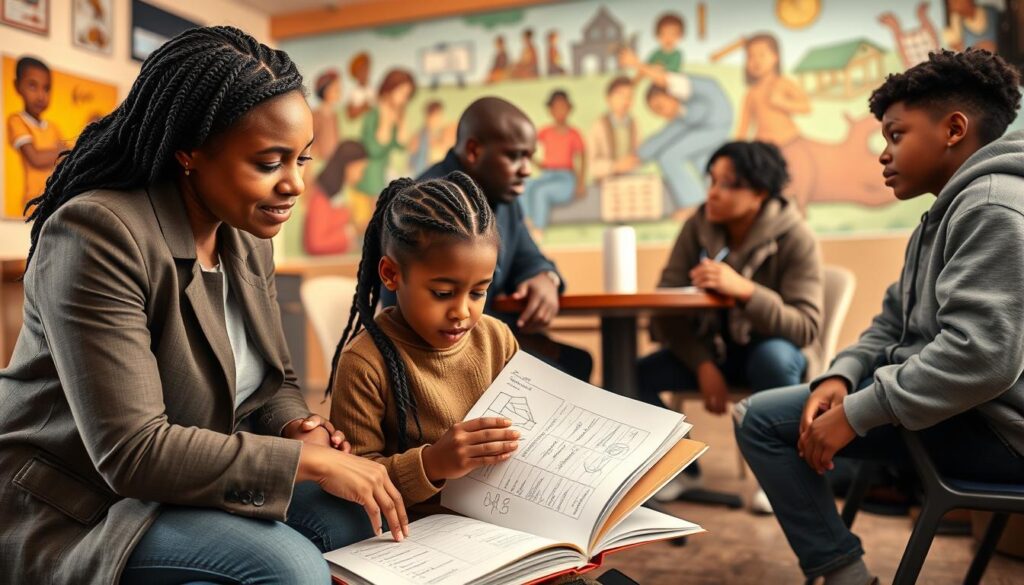
Research shows these experiences are common. Studies show how the school culture can cause psychological distress for Black and Latinx students. They struggle to feel like they belong while trying to do well in school.
When we listen to urban underserved students, we hear the same things:
- The exhaustion of constantly proving their intelligence
- The frustration with curriculum that doesn’t relate to their culture
- The emotional toll of being treated as exceptions instead of expectations
These voices show the gap between what policies promise and what happens in classrooms. It’s like using Band-Aids for major surgery. The solution isn’t more top-down reforms—it’s amplifying family engagement and using student feedback in teaching.
When students say they need teachers who believe in them, that’s not just a story—it’s data. When parents talk about fighting for basic resources, that’s not just a complaint—it’s a sign of a bigger problem.
Amplifying these voices isn’t just about feeling sorry for them. It’s about holding ourselves accountable. Once you’ve heard these stories, you can’t ignore them anymore.
Next Steps for Urban Advocacy
So where do we go from here? Advocacy is more than just waving signs. It’s using data and policy to make real change. We need a strong plan that actually works.
Funding is key. We need more than just a little bit of money. Urban equity schools need enough resources to tackle their big challenges.
Then, there’s the importance of people. Teachers from dominant groups must work for equity, not just as a favor. They need training that’s both tough and relevant, so they can help students in the real world.
Mental health programs need everyone’s help, not just orders from above. Schools should use evidence to guide their methods, not just old ways. They must value diversity in a real way, not just as a buzzword.
Policy changes must be strong. Everyone, from policymakers to principals, must be held accountable. Equality is a right, not a favor we give.
The next steps are big, not small. We’re aiming for urban equity schools that celebrate difference. Every kid deserves a real chance, not just a spirit to fight with.
James develops culturally responsive teaching frameworks and equity audit tools used by
over 150 school districts. A former high school teacher, he brings classroom experience to…