

Let’s talk about the children who aren’t in the room. While wealthy families enjoy enrichment activities, others are left out.Your ZIP code affects your opportunities. High-income families keep participating, but access drops for others.Children with disabilities face big barriers. The pandemic made these gaps worse, not created them.When 76% of families lose income due to…
Let’s talk about the children who aren’t in the room. While wealthy families enjoy enrichment activities, others are left out.
Your ZIP code affects your opportunities. High-income families keep participating, but access drops for others.
Children with disabilities face big barriers. The pandemic made these gaps worse, not created them.
When 76% of families lose income due to lack of care, it’s a huge problem. This issue hits teenagers hard, leading to educational ageism.
To fix this, we need early intervention programs. We must rethink who gets help and when.
Outreach Models
Ever wondered why some programs are super popular while others are quiet? It’s not just about better marketing. It’s about building real connections with the community.
Think about it. That flyer in the backpack? It’s like a snowball in Phoenix – it doesn’t last long. But a coach texting a player or a teacher knowing who needs help? That’s how you really get people interested.
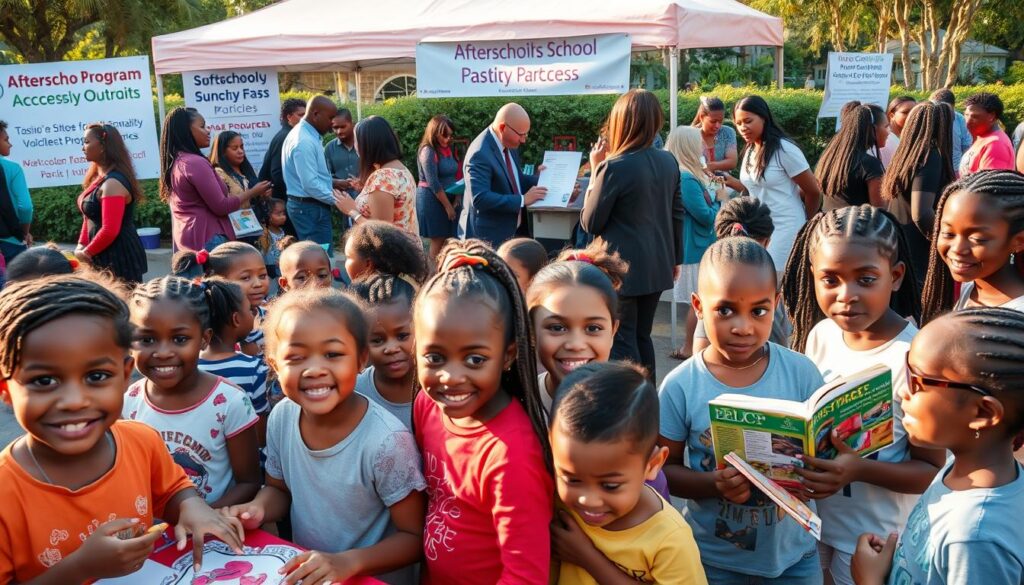
The best afterschool program access models know something key: trust comes from within the community. They use “trusted adults and peers” – people who are already respected by students.
What makes outreach successful or not? Here’s the difference:
- Benefit-driven messaging: Instead of “we offer STEM activities,” it’s “build robots that might impress your crush”
- Barrier demolition: Treating transportation as an economic justice issue, not a logistics problem
- Cost sensitivity: Recognizing that $20 might as well be $200 for some families
- Location intelligence: Using familiar community spaces instead of institutional buildings
This approach makes outreach more personal. It’s the difference between a party nobody shows up to and a movement everyone wants to join.
The same goes for inclusive summer learning programs. Successful ones don’t just open their doors. They actively remove obstacles. They know that being accessible means more than just physical space.
According to recent research, the best programs talk about benefits that matter to students. They focus on skills and social connections. They also tackle real barriers and offer programs where they’re needed most.
This isn’t rocket science – it’s about understanding people. The programs that do well are those that listen to the community. They know that the best strategy is a real conversation, not just a campaign.
So, when planning your program’s outreach, ask yourself: Are we sending flyers, or are we building relationships? The answer could make all the difference between a program that’s just another empty room or a true community hub.
Empowering Staff
Staff training isn’t just about following rules. It’s about turning anxiety into skill. Trained educators don’t just accept inclusion; they lead it. They make programs work.
Staff who get the right training become inclusion experts. They’re more likely to offer help and adjust activities. This makes places like wheelchair ramps more than just rules.

These teachers don’t see help as a hassle. They see it as a challenge. They turn simple things into big solutions. The best inclusive summer learning programs know this isn’t magic; it’s a plan.
Professional development should be memorable, not boring. It should mix online learning with face-to-face teamwork. This way, staff don’t just follow rules; they make new ones.
Numbers show that 96% of trained staff find the training useful. This isn’t just theory. It’s real help in afterschool program access situations.
True empowerment makes asking for help normal. It’s like building a superhero team. You’re preparing people for real-life challenges.
The most successful programs have staff who:
- Feel more confident in supporting diverse learners
- Are more creative in adjusting activities
- Know more about autism and ADHD strategies
- Don’t see help as extra work
This isn’t about making perfect teachers. It’s about making professionals who excel in real-world situations. That’s what makes programs truly stand out.
Activity Examples
Let’s get real about what really works in youth programs. Seven key skills make ordinary activities into powerful learning tools.
Forget the debate over basketball or board games. Kids can create urban gardens to tackle food deserts. They learn by planning, feeding their community, and understanding agriculture.
Summer learning should be exciting, not like detention. The best programs are like innovation labs. Teens can make podcasts about local history or apps for community problems.
These programs focus on belonging, not fitting in. They create spaces where every kid’s view is valued. The best activities feel like adventures, not lessons.
| Traditional Activity | Superpower-Enhanced Version | Engagement Elements | Real-World Example |
|---|---|---|---|
| Art class | Public mural project | Agency + Relevance + Exposure | Teens redesigning subway stations |
| Science lesson | Environmental testing lab | Competence + Safety/Wellness | Testing local water quality |
| Book club | Storytelling podcast | Belonging + Competence | Interviewing community elders |
| Sports practice | Community fitness initiative | Exposure + Wellness | Designing park workout courses |
| Cooking lesson | Social enterprise cafe | Relevance + Agency | Student-run pop-up restaurants |
Each enhanced activity offers many ways to engage. This is the key. Robotics programs become workshops for solving community problems. Cooking classes become cultural exchanges and science labs.
These programs show that the best learning happens when kids don’t even realize they’re learning. They’re too busy creating, building skills, and making a difference in their world.
Evaluating Outcomes
We’ve been measuring afterschool programs all wrong. We focus too much on test scores, missing the real magic. The quiet kid leading a group project. The struggling reader explaining complex concepts. These moments matter more than any test score.
Research shows most evaluations focus on academic achievement. But they ignore what truly builds resilient humans. We need frameworks that capture self-efficacy and community engagement, not just attendance numbers. Real afterschool program access means measuring whether spaces feel safe, not just whether they’re technically safe.
The most insightful evaluations understand impact isn’t always immediate. That quiet kid might become a community organizer years later. That’s the real ROI of inclusive summer learning programs – they build humans, not test-takers.
It’s time we stopped judging fish by their ability to climb trees. Let’s measure what actually matters in human development. The confidence boosts. The conflict resolutions. The social skills developed over shared paintbrushes. That’s where true transformation lives.
James develops culturally responsive teaching frameworks and equity audit tools used by
over 150 school districts. A former high school teacher, he brings classroom experience to…