
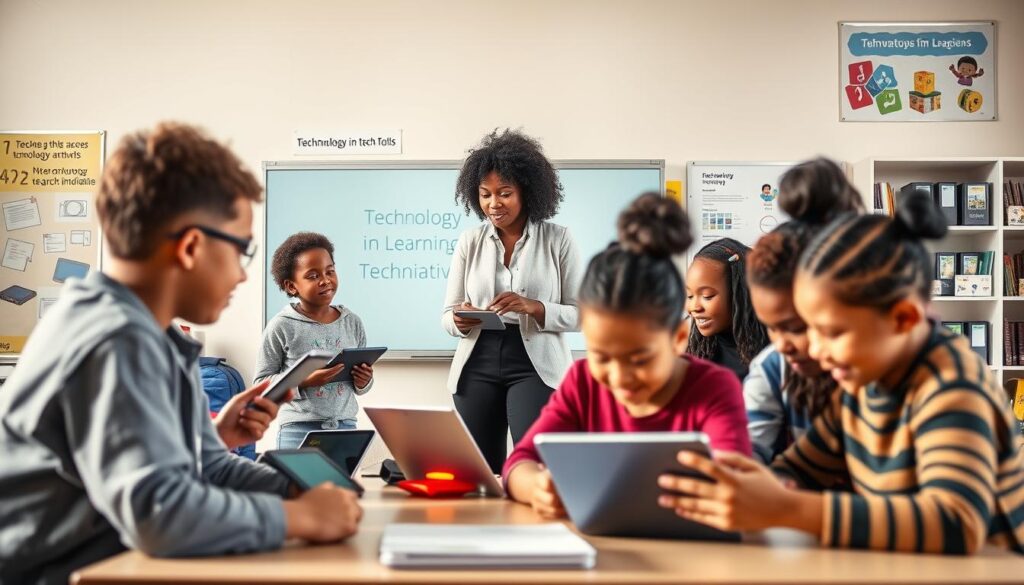
Remember chalkboards? They’re as useful today as a Blockbuster membership. We’ve moved far beyond those old relics.Now, classrooms use digital content libraries that are huge. They have learning management systems that actually help with learning. It’s a big change.Students can easily find scholarly articles like they scroll TikTok. Virtual field trips to places like the…
Remember chalkboards? They’re as useful today as a Blockbuster membership. We’ve moved far beyond those old relics.
Now, classrooms use digital content libraries that are huge. They have learning management systems that actually help with learning. It’s a big change.
Students can easily find scholarly articles like they scroll TikTok. Virtual field trips to places like the Grand Canyon are better than any textbook. AI tools like Explorance MLY analyze data fast, not slow.
This change isn’t just about new gadgets. It’s a big change in how we learn. Yet, as these education tech initiatives grow, we must make sure everyone gets to use them.
Let’s explore how these big changes are changing education.
Case Studies
Forget theory – let’s look at schools that made digital transformation real. While many were struggling with Zoom, these schools were creating systems that would amaze even Tony Stark.
Liverpool John Moores University ditched old feedback methods for AI analysis. This new approach uncovered student insights like Sherlock Holmes. Professors could now see patterns and predict challenges, truly understanding their students.
Boise State University took course evaluations to the next level with Explorance Blue. They didn’t just collect feedback; they used it to predict challenges. This system turned vague complaints into actionable insights quickly.
But all this success relies on robust broadband for schools. We’re talking about fast, reliable internet, not the weak WiFi that fails during exams. Internet access is as essential as oxygen for digital learning.
The American Foundation for the Blind’s research highlights the importance of proper access infrastructure for fair education. Schools with good broadband enable more than just downloads; they open up new possibilities.
Here’s what sets the winners apart:
| Institution | Technology Implemented | Outcome | Broadband Requirement |
|---|---|---|---|
| Liverpool John Moores University | AI Feedback Analysis | 25% faster response to student needs | Enterprise-grade fiber connectivity |
| Boise State University | Explorance Blue System | 40% increase in actionable feedback | Multi-gigabit campus network |
| K-12 District Implementation | Cloud-based learning platforms | Zero downtime during peak usage | Municipal broadband partnership |
Notice a pattern? The schools that excelled in digital education didn’t just buy software. They built strong foundations. Their broadband was a key investment, not an afterthought.
These examples show that tech initiatives need solid digital plumbing to succeed. You can’t run AI without stable internet, and cloud platforms need fast bandwidth.
The schools that succeeded saw broadband for schools as essential. They invested in infrastructure that supported their tech goals, not just looked good.
The main lesson is to focus on the foundation. Don’t just add tech without building a strong base. A solid foundation is key to real transformation in education.
Lessons Learned
Getting technology into schools is more than just buying devices. It’s about having a solid plan. Just like how a Ferrari is useless without a driver, tablets are useless without a strategy.
Our efforts have shown that having a plan is key. The SAMR model helps us use technology wisely. It’s not just about using tech; it’s about changing how we learn.
TPACK is another important concept. It combines technology, teaching, and content knowledge. It’s like the Avengers teaming up for education. Schools often fail because they focus on just one area.

Teacher training is a big issue. If most teachers don’t know how to use AI, we have a problem. Schools need to make sure teachers are ready for new tech.
Implementing new tech is hard. The biggest challenge is getting everyone to change. Schools move slowly, while tech changes fast.
So, what makes education tech work? Here’s what we’ve found:
| Integration Level | Teacher Comfort | Student Impact | Technology Use |
|---|---|---|---|
| Sparse | Basic digital literacy | Minimal enhancement | Substitution only |
| Emerging | Growing confidence | Moderate engagement | Some augmentation |
| Seamless | Full mastery | Transformative learning | Redefinition achieved |
The main lesson is simple. Technology alone is just entertainment. The real key is having well-trained teachers who know how to use it.
Sustainable Models
Most school tech plans don’t last long. Remember SMART Boards? They didn’t last. Sustainable tech is about creating digital ecosystems that evolve, not fade away.
Good models treat tech like a living thing. They know today’s tech can become tomorrow’s junk without growth. So, they invest in broadband for schools that grows with needs.

Why is bandwidth important? It’s because 4K virtual field trips need a lot of bandwidth. The difference between good tech and junk is often if the network can handle it.
Great models use the “TPACK framework on steroids.” They know tech knowledge is useless without:
- Pedagogical expertise to use it well
- Content knowledge that improves learning
- Professional development in daily practice
These schools plan for tech to become outdated. They avoid big purchases and instead have rolling refresh cycles to keep tech up-to-date without spending too much.
The magic is when tech becomes normal. Teachers don’t think “I’m using tech today.” They think “I’m teaching today, and tech helps me.” That’s the sustainable model: where innovation is as natural as breathing.
Teacher and Student Feedback
Remember when classroom tech was just overhead projectors and VHS tapes? Those were simpler times. Now, education tech initiatives have made a digital world where feedback moves fast. The NSSE’s 2021 study found that students in physical classrooms were 37% more engaged than those online. But, technology isn’t the problem here.
Teachers were initially wary of AI tools, thinking they might replace them. But, these systems help with tasks, letting teachers focus on what matters most: connecting with students. It’s like having a never-tiring teaching assistant.
Student feedback has changed from vague comments to detailed, useful insights. They can tell which digital tools help and which are just busywork. This isn’t just collecting data; it’s a real conversation where schools listen. The research shows that tech can boost engagement when it supports human interaction.
AI tools like Explorance MLY find patterns that teachers can’t. They see when student engagement drops and which discussions work best. It’s like having X-ray vision into the classroom.
Teachers now design curricula with tech in mind, not just adding it. They create digital experiences that work well with personal mentorship. One teacher called it “a symphony of silicon and sentiment.”
Policy makers need to know: just buying software isn’t enough. Experts say that lasting change needs training and support. Teachers must lead this digital transformation, not just follow it.
Students are now experts in evaluating education tech initiatives. They know the difference between tools that change learning and those that just distract. Their feedback is shaping the future of learning platforms, demanding better designs.
This change shows that tech, used wisely, can bring people together. The future of education isn’t about picking between humans and AI tools. It’s about using both to make learning experiences that are both advanced and personal.
Grant Writing Tips
Let’s talk money – because vision without funding remains a hallucination. Successful grant writing for technology initiatives means understanding funders want impact, not inventory lists. Don’t just request thirty iPads; show how they’ll change literacy outcomes in measurable ways.
Platforms like DonorsChoose have changed educational finance, making crowdfunding real for classroom tech. When seeking broadband for schools grants, think beyond “faster internet” to “enabling technologies previously impossible.” Frame it as surgical training equipment, not just WiFi.
STEM grants often favor partnerships with tech companies – many want educational success stories almost as much as sales. Implementation costs matter more long-term than the initial hardware price tag. That 3D printer’s materials budget will determine its actual educational value.
Effective broadband for schools proposals show how upgraded connectivity enables medical students to practice virtual surgeries or connects rural classrooms to global experts. Funders support solutions, not shopping lists. The right infrastructure becomes the invisible foundation for everything else.
James develops culturally responsive teaching frameworks and equity audit tools used by
over 150 school districts. A former high school teacher, he brings classroom experience to…