
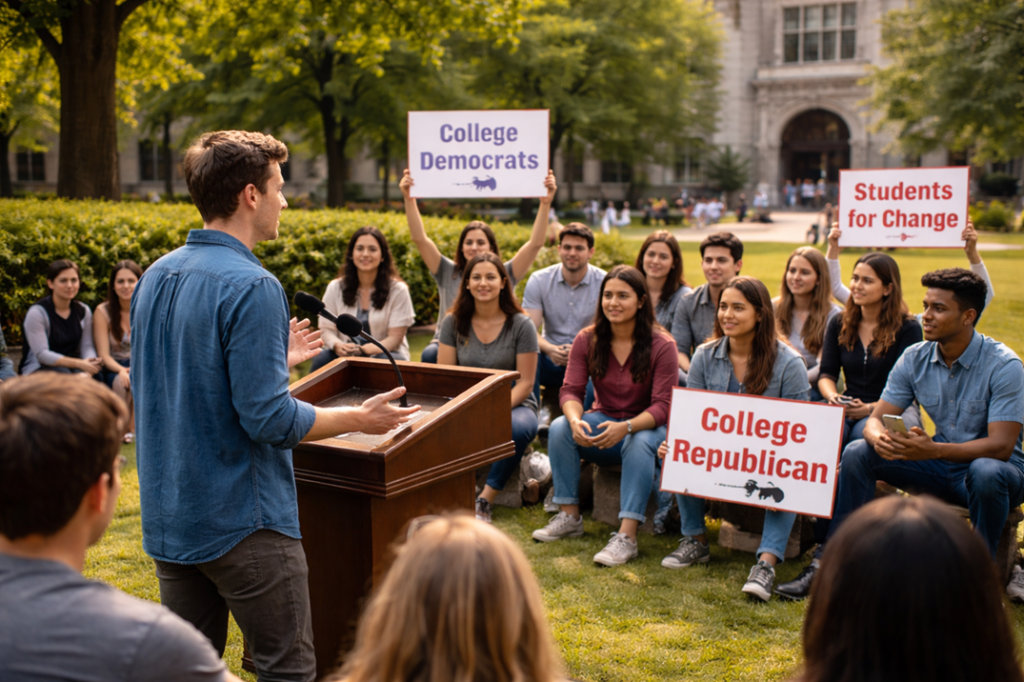
Student political organizations have long been a core feature of university life. These groups allow students to organize around ideas, participate in democratic processes, and develop leadership skills that often shape future civic engagement. On many campuses, political clubs represent national parties, advocacy movements, or issue-based campaigns. Their activities range from organizing debates and voter…
Student political organizations have long been a core feature of university life. These groups allow students to organize around ideas, participate in democratic processes, and develop leadership skills that often shape future civic engagement.
On many campuses, political clubs represent national parties, advocacy movements, or issue-based campaigns. Their activities range from organizing debates and voter registration drives to hosting speakers and influencing student government policy.
However, when controversy arises within these organizations, universities face a difficult challenge: balancing freedom of association with their responsibility to ensure a safe and inclusive campus environment.
Recent events at the University of Florida have placed this tension at the center of a national conversation about campus governance.
The University Of Florida Controversy
The University of Florida recently deactivated its campus chapter of the College Republicans after reports that some members engaged in antisemitic behavior. The statewide organization overseeing the group determined that certain members had repeatedly violated its standards, including through a widely criticized antisemitic gesture.
University officials announced that the student organization could eventually be reinstated under new leadership once the broader federation determines the group has restructured its governance and accountability systems.
The decision triggered debate among students, policymakers, and free-speech advocates. Some supported the university’s response as necessary to protect student safety and prevent harassment. Others argued the move raised concerns about whether universities are overstepping when regulating political organizations on campus.
This disagreement reflects broader tensions across American higher education.
How Campus Political Groups Operate Within University Governance
Most universities formally recognize student organizations through a registration process that provides access to campus resources. Recognized groups may receive funding, reserve campus spaces, and participate in institutional governance structures.
In exchange, these organizations must follow university policies that typically include:
| Governance Requirement | Purpose |
|---|---|
| Codes of conduct | Prevent harassment, discrimination, and intimidation |
| Leadership accountability | Ensure responsible organizational management |
| Event approval procedures | Maintain campus safety and logistics |
| Anti-discrimination policies | Protect inclusive participation in student activities |
These frameworks are designed to protect student expression while preventing behavior that undermines campus safety.
When controversies occur, universities must determine whether an organization’s actions violate these institutional standards.
The Tension Between Free Speech And Student Safety
The University of Florida case illustrates a challenge facing institutions nationwide: how to respond when political expression intersects with discriminatory behavior.
Political groups often engage in intense debate and ideological disagreement. Universities typically protect this activity as part of academic freedom and democratic engagement.
However, when rhetoric or actions cross into harassment, threats, or discriminatory conduct, universities may intervene. In some cases, administrators suspend or deactivate student organizations while investigations take place.
This balancing act reflects the broader role universities play as both educational institutions and communities responsible for student wellbeing.
National Trends In Campus Political Controversies
The University of Florida situation is not an isolated event. Universities across the United States have faced similar controversies involving student political groups, protests, and online communications.
In several cases, leaked group chats or social media posts linked to student organizations revealed racist, antisemitic, or misogynistic language. These incidents sparked investigations and disciplinary action at multiple universities.
As political polarization intensifies nationally, student organizations often become arenas where broader societal conflicts play out on campus.
This dynamic has forced universities to reconsider how student groups are supervised and supported.
Institutional Responses To Political Organization Controversies
Universities typically respond to student group controversies using a combination of disciplinary procedures, policy enforcement, and educational interventions.
Common responses include:
- Temporary suspension of student organization status
- Investigations into policy violations
- Leadership restructuring requirements
- Mandatory training programs addressing discrimination and bias
The goal of these responses is not only to address individual incidents but also to reinforce expectations for responsible leadership within student organizations.
Many administrators emphasize that campus political groups can only function effectively when they operate within shared institutional values.
The Role Of Student Governance And Accountability
Another important aspect of these controversies is the role of student governance systems.
Student governments frequently oversee recognition processes, funding decisions, and accountability structures for campus organizations. When conflicts arise, student leaders often participate in investigations or policy reviews.
This participatory model reflects the broader principle that universities are communities where students share responsibility for shaping institutional culture.
As explored in discussions about student leadership in education reform, participatory governance can strengthen both accountability and institutional trust.
Why Campus Climate Matters For Political Participation
The debate surrounding student political groups is ultimately connected to a larger question: how can universities foster active civic participation while ensuring that all students feel safe and respected?
Political engagement is an essential component of higher education. Universities often encourage students to debate controversial ideas, challenge assumptions, and participate in democratic processes.
Yet these goals must coexist with policies that protect students from discrimination and intimidation.
When campus governance systems function effectively, they allow political organizations to thrive while maintaining an environment of mutual respect.
What The Florida Controversy Reveals About The Future Of Campus Governance
The University of Florida case highlights the evolving responsibilities universities face as political engagement on campuses becomes more visible and contentious.
Institutions must navigate competing priorities: protecting freedom of expression, ensuring student safety, and maintaining trust within diverse academic communities.
While each controversy presents unique circumstances, the underlying governance challenge remains consistent.
Universities must build transparent systems that allow political participation while clearly defining the boundaries of acceptable conduct.
As campus politics continues to intersect with national debates, the ability of universities to manage these tensions will play a crucial role in shaping the future of student leadership and democratic engagement in higher education.
For a broader overview of how institutions manage campus speech and civic participation, research from the American Council on Education’s campus governance initiatives highlights how universities nationwide are adapting governance models to address political polarization while protecting academic freedom.
James develops culturally responsive teaching frameworks and equity audit tools used by
over 150 school districts. A former high school teacher, he brings classroom experience to…