
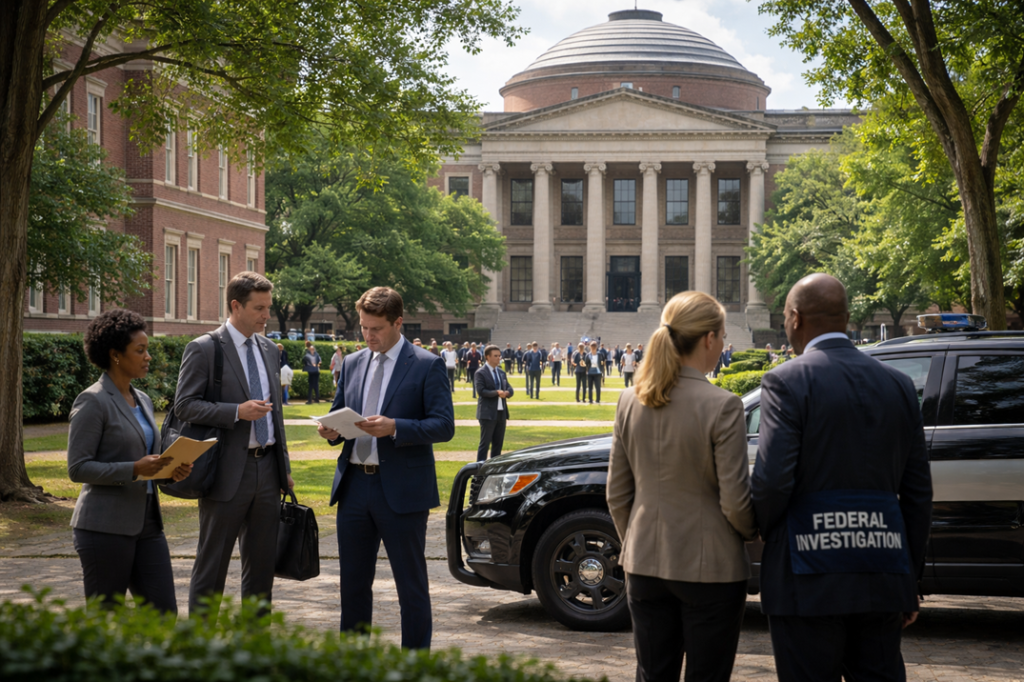
Recent federal scrutiny of Harvard University has placed campus climate at the center of national higher education policy debates. Investigations tied to allegations of antisemitism and admissions bias signal a broader shift in how federal agencies are interpreting and enforcing civil rights protections under Title VI of the Civil Rights Act. While federal oversight of…
Recent federal scrutiny of Harvard University has placed campus climate at the center of national higher education policy debates. Investigations tied to allegations of antisemitism and admissions bias signal a broader shift in how federal agencies are interpreting and enforcing civil rights protections under Title VI of the Civil Rights Act.
While federal oversight of universities is not new, the scale and visibility of these investigations suggest a transition from reactive enforcement to a more proactive, systemic approach. Institutions are no longer evaluated solely on formal policy compliance but increasingly on the lived experiences of students and the effectiveness of their responses to discrimination claims.
This shift reflects a growing expectation that universities must demonstrate not just legal adherence, but measurable impact in creating safe and inclusive environments.
Title VI Enforcement And The Expanding Definition Of Campus Climate
Title VI prohibits discrimination based on race, color, or national origin in federally funded programs. Historically, enforcement focused on explicit acts of discrimination. Today, however, federal agencies are placing greater emphasis on campus climate—how students perceive safety, inclusion, and institutional responsiveness.
The Harvard case illustrates how this expanded lens operates in practice. Allegations related to antisemitism are being evaluated not only through individual incidents, but through patterns of institutional response, reporting mechanisms, and administrative accountability.
This evolution raises important questions for universities nationwide:
- What constitutes a “hostile environment” in a modern campus context?
- How should institutions measure climate beyond surveys and compliance reports?
- What level of response is considered sufficient under federal scrutiny?
As outlined by the U.S. Department of Education’s Office for Civil Rights, institutions are expected to take “prompt and effective action” when discrimination is identified—a standard that increasingly includes prevention, not just reaction (see civil rights enforcement guidance from the U.S. Department of Education).
From Compliance To Accountability: Institutional Risk Is Changing
The implications of these investigations extend far beyond Harvard. Universities across the United States are now facing a recalibrated risk landscape where reputational, financial, and regulatory consequences are closely intertwined.
The table below highlights how institutional expectations are evolving:
| Area | Traditional Approach | Emerging Expectation |
|---|---|---|
| Compliance | Policy documentation and reporting | Demonstrated impact and responsiveness |
| Campus Climate | Periodic surveys | Continuous monitoring and intervention |
| Incident Response | Case-by-case handling | Pattern recognition and systemic reform |
| Leadership Accountability | Delegated to compliance offices | Shared across senior administration |
| Student Engagement | Advisory or symbolic roles | Active participation in governance |
This shift toward accountability reflects a broader policy trend: universities are being evaluated as ecosystems, not just institutions. Failures in one area—such as delayed response to student complaints—can now be interpreted as systemic deficiencies.
Student Experience As Evidence: The Role Of Data And Reporting

One of the most significant changes in federal investigations is the growing reliance on student-reported experiences as evidence. Surveys, complaint data, and qualitative accounts are increasingly central to determining whether a campus environment meets civil rights standards.
This aligns with broader trends in education policy, where data is used not only for performance measurement but for identifying risk. Similar to how institutions use early warning data systems to detect academic disengagement, federal agencies are now applying comparable frameworks to issues of safety and discrimination.
However, this approach introduces new challenges. Data collection methods vary widely across institutions, and student willingness to report incidents is influenced by trust, transparency, and perceived consequences. Without consistent standards, universities risk both underreporting and misinterpreting critical signals.
The Harvard investigations highlight the importance of aligning internal data systems with external accountability expectations. Institutions that fail to do so may find themselves unprepared for federal scrutiny.
Governance, Leadership, And The Politics Of Institutional Response
Civil rights investigations are not purely administrative processes—they are deeply tied to governance structures and leadership decisions. At Harvard, public pressure, internal divisions, and external political scrutiny have all shaped the university’s response.
This dynamic is increasingly common. University leaders must navigate competing demands from students, faculty, alumni, policymakers, and the public. Decisions about speech, protest, disciplinary action, and resource allocation are no longer viewed in isolation; they are interpreted as signals of institutional values.
The growing complexity of these decisions reinforces the importance of participatory governance. Institutions that incorporate meaningful student voice frameworks into decision-making processes are better positioned to anticipate conflicts and respond in ways that are both effective and credible.
Without such structures, universities risk reactive governance—responding to crises after they escalate rather than preventing them through inclusive policy design.
What Universities Must Rethink Moving Forward
The Harvard case is not an outlier; it is an indicator of where higher education policy is heading. Federal civil rights enforcement is becoming more data-driven, more expansive in scope, and more closely tied to institutional accountability.
For universities nationwide, this means rethinking several core assumptions:
- Compliance alone is no longer sufficient; outcomes matter.
- Campus climate must be continuously assessed, not periodically reviewed.
- Student experiences are central to policy evaluation, not peripheral.
- Leadership decisions carry regulatory as well as reputational consequences.
These shifts require more than incremental adjustments. They demand structural change in how institutions design policies, collect data, and engage with their communities.
Reframing Campus Climate As A Public Responsibility
At its core, the growing focus on civil rights investigations reflects a broader societal expectation: universities are not just places of learning, but public institutions with responsibilities to equity, safety, and inclusion.
The Harvard investigations underscore that campus climate is no longer an internal matter—it is a public concern subject to federal oversight and national scrutiny. Institutions that recognize this shift and adapt proactively will be better equipped to navigate the evolving policy landscape.
Those that do not may find themselves defined not by their academic achievements, but by their failures to meet the standards of equity and accountability that modern education demands.
James develops culturally responsive teaching frameworks and equity audit tools used by
over 150 school districts. A former high school teacher, he brings classroom experience to…